 |
| Word Press |
Monday, September 11, 2017


Sunday, September 10, 2017
"Most Evangelical Christians Say Science and Religion Can Coexist," Megan Gannon

"Never mind the outspoken Christian leaders who reject the Big Bang and human evolution; nearly 70 percent of rank-and-file evangelicals in the United States say they don't see religion and science as being totally at odds, a new survey found.
'Although many politicians and the media at large portray evangelicals as distrustful of science, we found that this is more myth than reality,' Elaine Howard Ecklund, a sociologist at Rice University who orchestrated the survey, said in a statement...."
"Ecklund and her colleagues think the perception that evangelical Christians are unfriendly to science might hinge on just a few of these hot-button issues, like creationism. The evangelicals who saw science and religion as incompatible often fixated on human origins, the study found. One survey participant who was part of a largely white evangelical congregation in Houston, Texas, explained this point of view to the interviewers:
'As a Christian, creation — really it's all or nothing. Either the entire Bible's right or it's all wrong. Either everything inside of it is 100 percent accurate, or none of it is. So if creation could be disproven … So just completely take that away, that just devastates my entire way of life, my entire being. … Nobody wants to change. Christians don't want to change, and atheists don't want to change....'" "...Science and Religion Can Co-Exist," Megan Gannon, Live Science, March 17, 2015.

Friday, September 8, 2017
Surrender

Waiting,
Hoping,
Listening
First distant then
Ominously approaching
In deafening waves
Inexplicably
The chorus engulfs
me,
Hysterically orgasmic
Drowning in
Roaring crescendos
Filling me-
Leaving me breathless
Lifting,
Transporting,
Transforming
Harmony of
Spirit and Being;
Life and Death:
Existential alchemy.
Melancholia,
Lars von Trier,
Opening Sequence
Monday, September 4, 2017
Mary

I remember her fondly and think of her often.
An immigrant from Monterrey, she seemed to love my mom and took care of all of us for years while both our parents worked.
She never learned English. I would imagine she thought her time here temporary even though she worked and lived most of her adult life in the U.S. Like the rest of us, sometimes circumstances interfered with her best laid plans and dreams.
Mary was probably one of many undocumented workers, living in the barrios of San Antonio before illegal immigration became a political issue. For us though, she was more than an employee paid in cash: Mary was a loyal friend.
Did you hear the bells ringing? An angel just earned her wings.
Friday, September 1, 2017
Sunday's with George
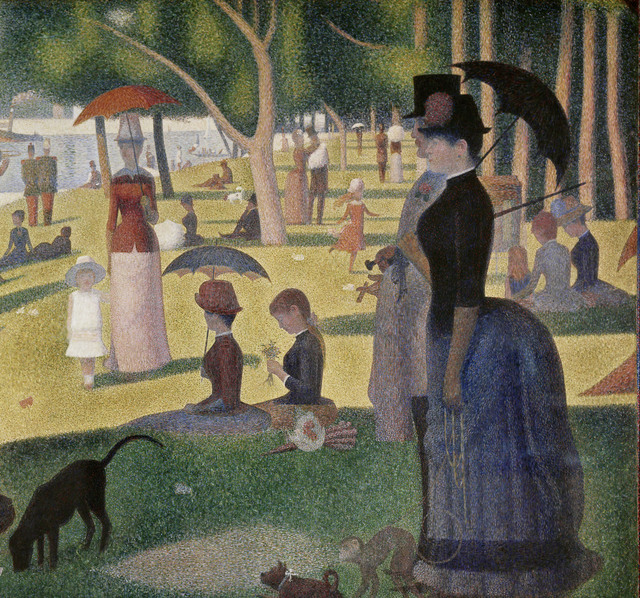
A Sunday On La Grande Jatte
"In his best-known and largest painting, Georges Seurat depicted people relaxing in a suburban park on an island in the Seine River called La Grande Jatte. The artist worked on the painting in several campaigns, beginning in 1884 with a layer of small horizontal brushstrokes of complementary colors. He later added small dots, also in complementary colors, that appear as solid and luminous forms when seen from a distance.
Seurat's use of this highly systematic and 'scientific' technique, subsequently called Pointillism, distinguished his art from the more intuitive approach to painting used by the Impressionists. Although Seurat embraced the subject matter of modern life preferred by artists such as Claude Monet and Pierre-Auguste Renoir, he went beyond their concern for capturing the accidental and instantaneous qualities of light in nature.
Seurat sought to evoke permanence by recalling the art of the past, especially Egyptian and Greek sculpture and even Italian Renaissance frescoes. As he explained to the French poet Gustave Kahn, 'The Panathenaeans of Phidias formed a procession. I want to make modern people, in their essential traits, move about as they do on those friezes, and place them on canvases organized by harmonies of color.' Some contemporary critics, however, found his figures to be less a nod to earlier art history than a commentary on the posturing and artificiality of modern Parisian society.
Seurat sought to evoke permanence by recalling the art of the past, especially Egyptian and Greek sculpture and even Italian Renaissance frescoes. As he explained to the French poet Gustave Kahn, 'The Panathenaeans of Phidias formed a procession. I want to make modern people, in their essential traits, move about as they do on those friezes, and place them on canvases organized by harmonies of color.' Some contemporary critics, however, found his figures to be less a nod to earlier art history than a commentary on the posturing and artificiality of modern Parisian society.
Seurat made the final changes to La Grande Jatte in 1889. He re-stretched the canvas in order to add a painted border of red, orange, and blue dots that provides a visual transition between the interior of the painting and his specially designed white frame," Georges Seurat, 1859-1891, ART INSTITUTE CHICAGO.
Steven Sondheim's
Sunday in the Park with George
Tony Awards 1984 with
Mandy Patinkin,
Bernadette Peters,
and Company
Sunday in the Park with George
Tony Awards 1984 with
Mandy Patinkin,
Bernadette Peters,
and Company
Subscribe to:
Posts (Atom)