
"...Virtual communities 'can fill a fundamental need we have for a sense of belonging, much like eating or sleeping,' said Anita Blanchard, a psychologist at the University of North Carolina at Charlotte who's studied them for 20 years.
Her research has also shown that online communities can make people less intolerant of opposing viewpoints. 'They get you out of your own clothes and make connections across the U.S., making you realize you can get along with people with different beliefs,' she said.
For Sarah Giberman, an artist and parent who lives in Arlington, Texas, a meaningful group is one 'that serves a need in your life, that fills some space that would otherwise feel vacant.'
'I spend a lot more time on Facebook because of the groups than I would otherwise,' she said. 'Especially with the current sociopolitical climate, I'm not comfortable being very open in my regular newsfeed,'" Facebook wants to nudge you into 'meaningful' online groups.
"The Salon was the engine of enlightenment. Now it's coming back. In the digital era the question might be different from the ones in the European cities of the 17th century. The rules are the same. Why is there such a great desire to spend some hours with like-minded peers in this age of the internet?"
"...The salon is still regarded as a mysterious world of thoughts and ideas, a world in which the participants soon were consigned to the role of historical figures in history books. In the early days of the salon culture these meetings were incubators of new ideas as well as the first form an urban and bourgeois culture.
The first salons were formed in Paris in the early 17th century, when the nobles left their estates and are gathered in the capital around the King. Initially, they cemented these early manifestations of bourgeois culture such as music and literature. But soon philosophers such as Voltaire and Diderot appeared in the 18th century and prepared the intellectual ground for the French revolution....."
"...In the digital era we might very well witness once again the phenomenon that Jürgen Habermas has called 'structural transformation of the public sphere,' the rise of a new bourgeoisie and mass society that began with the salons. There is no across-the-board answer to this question, that's impossible when the structural transformation of the digital age affects various spheres of the international community differently.
In Europe and America, digital media always leads to new cul-de-sacs and roundabouts of communication. Social networks claim to be not only the successors of salons, they evoke the ominous metaphysical principle of the Weltgeist (global mind), while they actually reduce the principle of intellectual eruptions in salons to a de-intellectualized white noise...,"Salon Culture: Network of Ideas.
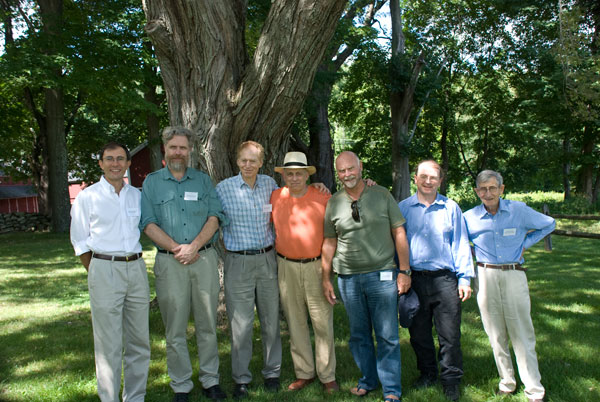 |
Salon of the 21st century: the literary agent John Brockman (Center, with Hat) in the circle of the scientists of the Edge network during one of his legendary weekends at Eastover Farm in Connecticut.
|

No comments:
Post a Comment
Note: Only a member of this blog may post a comment.